
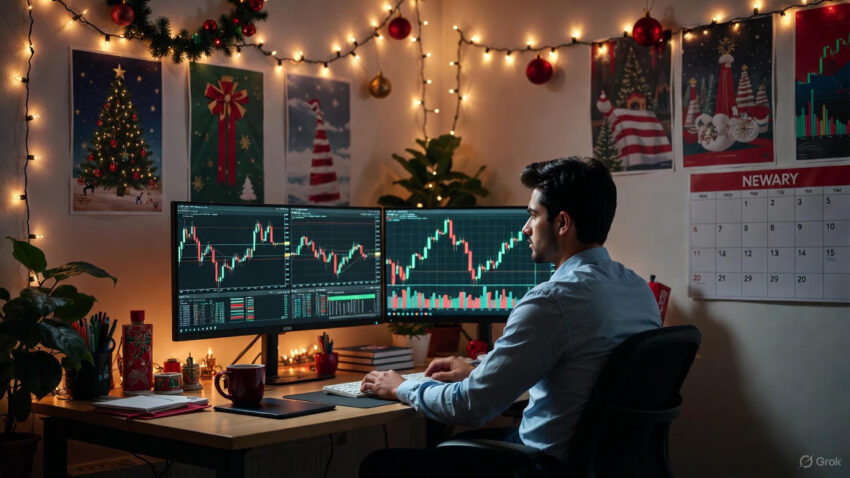
Pros and Cons of Trading Forex During Holidays
Trading forex during holidays like Christmas, New Year, or national bank holidays can seem tempting with extra time on your hands. But the reality is harsh: low liquidity often turns the market into a minefield with wider spreads, erratic moves, and higher risks. Most retail traders are better off stepping away, but if you’re experienced and risk-tolerant, there might be niche opportunities. Here’s the straight breakdown.
The forex market runs 24/5 and stays technically open during most holidays since it’s decentralized. Major closures hit on Christmas Day (Dec 25) and New Year’s Day (Jan 1), when nearly all brokers shut down due to global thin trading. Bank holidays in key centers (US, UK, Europe, Japan) reduce volume sharply without full closure.
What Does “Trading Forex During Holidays” Actually Mean?
When traders talk about trading Forex during holidays, they usually mean trading during:
-
Major bank holidays (US, UK, EU, Japan)
-
Public holidays that shut down financial institutions
-
Periods like Christmas, New Year, Easter, or Thanksgiving
-
Overlaps where one major market is closed and others are open
Forex markets are technically open 24/5, but liquidity depends on banks, institutions, and large market makers. When they’re away, the market behaves differently.
Why Holiday Trading Is So Different
During holidays, the Forex market doesn’t stop—but it becomes thin.
That leads to:
-
Fewer active participants
-
Lower trading volume
-
Wider bid-ask spreads
-
Sudden, exaggerated price moves
This environment changes how strategies perform—and whether trading even makes sense.
Pros of Trading Forex During Holidays
Holiday trading isn’t automatically bad. In some cases, it can work—if you know exactly what you’re doing.
1. Lower Competition From Institutions
When major banks and hedge funds are offline:
-
Fewer large orders dominate price
-
Retail traders aren’t competing with heavy institutional flow
-
Certain technical levels may hold more cleanly
For experienced traders, this can feel like a quieter battlefield.
2. Sharp, Fast Price Moves on Low Volume
Low liquidity can amplify price movements.
That means:
-
Small orders can move price more than usual
-
Breakouts may happen faster
-
Short-term momentum trades can pay off quickly
This is why some scalpers and short-term traders are attracted to holiday sessions.
3. Cleaner Ranges in Some Sessions
Not all holiday markets are chaotic.
Sometimes you’ll see:
-
Tight, well-defined ranges
-
Respect for support and resistance
-
Predictable intraday behavior
For range traders, this can be useful—especially during Asian sessions on Western holidays.
4. Fewer News Releases and Macro Surprises
Many economic calendars go quiet during major holidays.
That reduces:
-
Sudden news-driven spikes
-
Unexpected macro volatility
-
Event risk from high-impact data
If your strategy struggles during news releases, holidays can feel calmer.
5. Practice and Observation Without Pressure
For developing traders, holiday markets can be used to:
-
Observe price behavior in low-liquidity conditions
-
Test execution quality
-
Practice discipline by trading smaller size
The key is not treating it like a normal trading day.
Cons of Trading Forex During Holidays
This is where most retail traders get burned.
1. Wider Spreads Eat Into Profits
One of the biggest issues is spread widening.
During holidays:
-
Liquidity providers widen spreads to manage risk
-
Cost of entry increases
-
Stop-losses get hit more easily
A strategy that works perfectly in normal conditions can become unprofitable overnight.
2. Slippage Is More Common
Low liquidity increases slippage risk.
That means:
-
You don’t get filled at your intended price
-
Stop-losses execute worse than expected
-
Risk management breaks down
This is especially dangerous for tight-stop strategies and scalping systems.
3. False Breakouts Are Frequent
Holiday markets love fake moves.
You’ll often see:
-
Price breaking key levels, then snapping back
-
Stop-hunting behavior
-
Moves without follow-through
Retail traders chasing breakouts tend to lose the most in these conditions.
4. Technical Analysis Becomes Less Reliable
Indicators and patterns rely on participation.
When volume drops:
-
Chart patterns lose statistical edge
-
Trend strength is misleading
-
Indicators give more false signals
Price may move—but not for the reasons your system expects.
5. Unpredictable Volatility Spikes
Holiday markets can be quiet for hours… then explode.
Causes include:
-
A single large order
-
Unexpected geopolitical headlines
-
Thin order books reacting violently
These spikes are hard to anticipate and harder to manage.
6. Poor Risk-to-Reward for Most Retail Traders
Even when trades work:
-
Execution costs are higher
-
Risk is harder to control
-
Rewards are inconsistent
For most traders, the math simply doesn’t justify active trading.
When Trading Forex During Holidays Might Make Sense
Holiday trading is situational, not routine.
It may make sense if:
-
You are highly experienced
-
You reduce position size significantly
-
You understand session-specific behavior
-
You trade simple, price-based setups
-
You accept that no trade is often the best trade
If you’re trading out of boredom, you’re already wrong.
When You Should Avoid Trading Forex During Holidays
You should strongly consider staying out if:
-
You rely on tight stops
-
You scalp frequently
-
You’re still developing consistency
-
You struggle with discipline
-
You feel pressure to “make something happen”
Professional traders are perfectly fine doing nothing. Retail traders often aren’t—and that’s the problem.
Common Forex Holidays That Affect Liquidity
| Holiday | Affected Markets | Typical Impact |
|---|---|---|
| Christmas / New Year | Global | Extremely low liquidity |
| US Thanksgiving | USD pairs | Thin NY session |
| Easter | Europe | Reduced EUR liquidity |
| Golden Week (Japan) | JPY pairs | Erratic moves |
| UK Bank Holidays | GBP pairs | Wider spreads |
Liquidity impact is highest when multiple financial centers are closed.
Practical Risk Management Tips for Holiday Trading
If you choose to trade anyway:
-
Reduce position size by 50–80%
-
Widen stops slightly—but reduce exposure
-
Avoid breakout strategies
-
Trade only the most liquid pairs (EUR/USD, USD/JPY)
-
Accept fewer trades
-
Close positions earlier than usual
Better yet: observe instead of trading.
Is Trading Forex During Holidays Profitable?
For a small subset of experienced traders—sometimes.
For the majority of retail traders—no.
Holiday trading rewards:
-
Patience
-
Experience
-
Capital preservation
It punishes:
-
Overtrading
-
Impatience
-
Mechanical systems optimized for normal liquidity
The market will still be there tomorrow.
Final Verdict: Should You Trade Forex During Holidays?
Trading Forex during holidays is not inherently wrong—but it’s structurally riskier. Lower liquidity, wider spreads, and unreliable price behavior shift the odds against most retail traders. For many, the smartest move is to step aside, protect capital, and return when real market participation comes back.
Doing nothing is a position. Often, it’s the best one.
FAQ: Trading Forex During Holidays
Is Forex open during holidays?
Yes, Forex is open 24/5, but liquidity depends on which financial centers are active.
Are spreads higher during Forex holidays?
Yes. Spreads often widen significantly due to reduced liquidity.
Is holiday trading good for beginners?
No. Beginners are more likely to misread price action and underestimate execution risk.
Which Forex pairs are safest during holidays?
Major pairs like EUR/USD and USD/JPY usually remain the most liquid—but still riskier than normal.
Do professional traders trade during holidays?
Most professionals reduce activity or stop trading entirely during major holidays.